Introduction
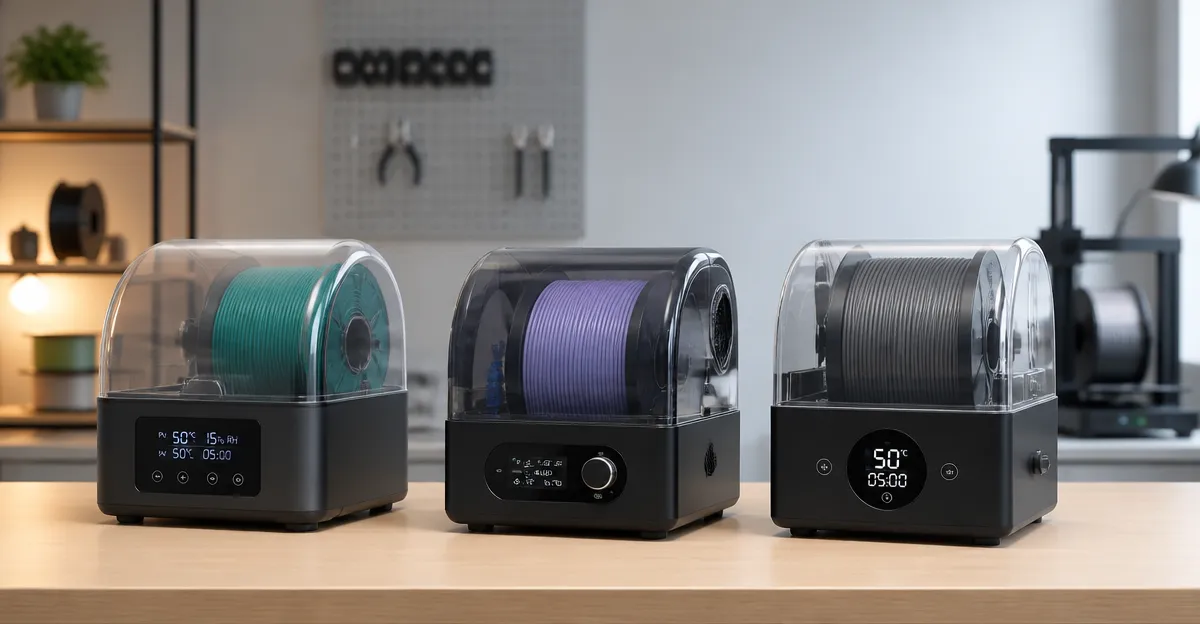
The market for 3D printer filament dryers has expanded as manufacturers recognize the impact of moisture on print quality. Dry filament prevents stringing, clogging, and poor layer adhesion, especially in humid environments. This article compares five popular dryer models—SUNLU S4 Filament Dryer, Comgrow Filament Dryer Box, SUNLU S2 Filament Dryer, SUNLU S1 Plus Filament Dryer, and Creality Space Pi Filament Dryer Plus. The analysis focuses on price, features, power consumption, capacity, and user feedback to help readers select the most suitable dryer for their workflow.
Individual Product Overviews
SUNLU S4 Filament Dryer
Priced at $99.44, the SUNLU S4 offers a large 4‑spool capacity and eight filament exit holes, allowing simultaneous drying for multiple printers. Its 350W PTC heater delivers 50% more heating efficiency than the earlier S2 model. The unit measures 460 × 220 × 310 mm externally and weighs 4 kg. Temperature can be set between 35 °C and 70 °C, with a timer up to 99 hours. Compatibility spans PLA, PETG, ABS, TPU, PA, PC, Nylon, and diameters from 1.75 mm to 3.00 mm. The package includes PTFE tubes, clips, and silicone plugs for flexible installation.
Comgrow Filament Dryer Box
At $43.99, the Comgrow dryer presents a compact design with an internal volume of 9.29 × 6.49 × 9.13 inches, fitting two 1 kg spools. The temperature range is limited to 40 °C‑50 °C, and drying time can be set from 6 to 12 hours. A 2‑inch LCD displays real‑time temperature and humidity. The sealed enclosure uses silicone cable sheaths and Teflon tubes to protect filament when not in use. The device supports both 1.75 mm and 2.85 mm filaments, including PLA, PETG, and ABS.
SUNLU S2 Filament Dryer
The SUNLU S2 is the most affordable SUNLU model at $38.24. It accommodates a single spool within a 265 × 274 × 118 mm footprint and features a touch screen for temperature (35 °C‑70 °C) and timer (0‑99 hours) adjustments. Heating is rapid, and a built‑in spindle ensures continuous filament rotation for even drying. Compatibility includes PLA, PETG, ABS, TPU, and diameters up to 3.00 mm. The translucent lid allows visual inspection without opening the unit.
SUNLU S1 Plus Filament Dryer
For $32.29, the SUNLU S1 Plus provides a modest capacity of 210 × 89 mm (height) and a 2‑inch LCD that shows temperature, time, and humidity. The temperature range is 35 °C‑55 °C. An upgraded fan accelerates moisture removal, improving print surface quality. The dryer accepts 1.75 mm, 2.85 mm, and 3.00 mm filaments across PLA, PETG, ABS, TPU, Nylon, and PA.
Creality Space Pi Filament Dryer Plus
Retailing for $79.00, the Creality Space Pi Plus combines a double‑roll capacity with a 160W PTC heater that circulates hot air 360° for uniform drying. Temperature is adjustable between 45 °C‑70 °C, and the unit supports up to 12 filament types, including high‑performance composites such as PLA‑CF and PETG‑CF. A 4‑inch touch screen provides one‑key presets and real‑time monitoring. The dryer is compatible with 1.75 mm, 2.85 mm, and Nylon/PA/PC diameters.
Head-to-Head Comparison
Price and Value
- SUNLU S4 – $99.44, premium price justified by four‑spool capacity and advanced heating.
- Comgrow – $43.99, mid‑range cost with basic temperature control.
- SUNLU S2 – $38.24, budget‑friendly for single‑spool users.
- SUNLU S1 Plus – $32.29, lowest price, suitable for hobbyists with limited space.
- Creality Space Pi – $79.00, offers high‑end features at a competitive price.
Features and Specifications
All five dryers provide temperature control, but the SUNLU S4 and Creality Space Pi stand out with higher wattage heaters (350W and 160W PTC respectively) and broader temperature ranges. The SUNLU S4 uniquely offers eight exit holes and DIY customization for large rolls. Comgrow relies on a simple LCD and sealed design, while the SUNLU S2 and S1 Plus emphasize user‑friendly touch interfaces.
Customer Ratings and Feedback
Average ratings range from 4.2 to 4.5 stars. The SUNLU S4 leads with 4.5/5 from 552 reviews, indicating strong satisfaction despite its higher price. Comgrow holds 4.4/5 from 4,712 reviews, reflecting popularity among budget‑conscious users. SUNLU S2 and S1 Plus each have 4.4/5 and 4.3/5 respectively, showing consistent approval. Creality Space Pi receives 4.2/5 from 414 reviewers, suggesting solid performance but slightly fewer endorsements.
Performance and Reliability
Higher wattage heaters translate to faster drying cycles. The SUNLU S4’s 350W PTC heater and three circulation fans provide rapid, uniform heating, reducing moisture-related print failures. Creality’s 160W PTC heater also offers even heating, though at a lower power level. The S2’s rapid heating and spindle design ensure consistent results for single spools. Comgrow’s lower temperature ceiling (max 50 °C) may be insufficient for some high‑temperature filaments such as Nylon.
Size, Power, Compatibility, and Price Summary
| Product | Price (USD) | Capacity | Power (W) | Temp Range (°C) | Compatible Diameters | Rating |
|---|---|---|---|---|---|---|
| SUNLU S4 | 99.44 | 4 spools (8 exits) | 350 | 35‑70 | 1.75 mm, 2.85 mm, 3.00 mm | 4.5 |
| Comgrow Box | 43.99 | 2 spools | Not specified | 40‑50 | 1.75 mm, 2.85 mm | 4.4 |
| SUNLU S2 | 38.24 | 1 spool | Not specified | 35‑70 | 1.75 mm, 2.85 mm, 3.00 mm | 4.4 |
| SUNLU S1 Plus | 32.29 | 1 spool (210 × 89 mm) | Not specified | 35‑55 | 1.75 mm, 2.85 mm, 3.00 mm | 4.3 |
| Creality Space Pi Plus | 79.00 | 2 spools (4 exits) | 160 (PTC) | 45‑70 | 1.75 mm, 2.85 mm, Nylon/PA/PC | 4.2 |
Pros & Cons
SUNLU S4 Filament Dryer
- Pros: Four‑spool capacity, eight exits, high‑power 350W PTC heater, broad material compatibility, DIY customization.
- Cons: Largest footprint, highest price, heavier unit.
Comgrow Filament Dryer Box
- Pros: Affordable, compact, simple LCD interface, good sealing.
- Cons: Limited temperature range, no multi‑material presets, power rating not disclosed.
SUNLU S2 Filament Dryer
- Pros: Low cost, rapid heating, spindle for even drying, touch screen.
- Cons: Single‑spool capacity, no fan‑enhanced airflow.
SUNLU S1 Plus Filament Dryer
- Pros: Very low price, fan‑assisted drying, LCD shows humidity.
- Cons: Smaller temperature range, limited capacity.
Creality Space Pi Filament Dryer Plus
- Pros: Dual‑spool capacity, 360° hot‑air circulation, one‑key presets for up to 12 filament types, robust PTC heater.
- Cons: Slightly lower power than SUNLU S4, price higher than basic models.
Recommendations
For users with limited bench space and a tight budget, the SUNLU S1 Plus provides essential drying at $32.29 and fits comfortably on small workstations. Professionals requiring high throughput and the ability to dry multiple spools simultaneously should consider the SUNLU S4, despite its larger footprint, because its eight exit holes and 350W heater ensure rapid, uniform drying for several printers. If the priority is a balance of price and dual‑spool capability, the Creality Space Pi Plus offers advanced PTC heating and a user‑friendly touch screen at $79.00. For hobbyists who only need to dry a single spool occasionally, the SUNLU S2 delivers reliable performance for $38.24. Finally, the Comgrow Box remains a solid entry‑level choice for users who value simplicity and a compact form factor.
FAQ
- What temperature is optimal for drying PLA?
- PLA generally dries well at 45 °C‑55 °C for 6‑12 hours. All five dryers cover this range.
- Can these dryers handle flexible TPU filament?
- Yes. SUNLU S4, S2, S1 Plus, and Creality Space Pi list TPU compatibility. The Comgrow model also supports TPU.
- Is a PTC heater better than a traditional heating pad?
- PTC heaters provide faster warm‑up, higher energy efficiency, and more uniform temperature distribution, reducing hot spots during drying.
- How many spools can I dry simultaneously?
- The SUNLU S4 supports four spools with eight exits, Creality Space Pi and Comgrow handle two spools, while SUNLU S2 and S1 Plus are single‑spool units.
- Do any of these units allow custom modifications?
- The SUNLU S4 explicitly offers DIY customization for drying large rolls or repurposing as a shoe dryer.
- What warranty or after‑sales support is provided?
- Comgrow and Creality both mention 24‑hour technical support. SUNLU products reference general after‑sales service, though specific warranty periods are not listed.
Conclusion
Choosing the right filament dryer depends on capacity needs, budget, and workspace constraints. The SUNLU S4 excels in capacity and heating power for professional environments, while the SUNLU S1 Plus offers an economical solution for limited spaces. Creality’s Space Pi Plus bridges the gap with dual‑spool capability and sophisticated controls. For occasional single‑spool drying, the SUNLU S2 provides excellent value. The Comgrow Box remains a viable low‑cost option for users who prioritize simplicity. By aligning the specific requirements of your 3D printing workflow with the strengths outlined above, one can select a dryer that maximizes print quality and operational efficiency.
Products Mentioned in This Review
Frequently Asked Questions
What are the main benefits of using a 3D filament dryer?
A dryer removes moisture that causes stringing, nozzle clogs, and weak layer adhesion, improving print quality especially in humid environments.
Which filament dryer offers the best value for its price?
The SUNLU S4 Filament Dryer, priced around $99, balances cost, capacity, and features, making it a strong value choice.
How does the Creality Space Pi Filament Dryer Plus differ from the SUNLU models?
The Creality model includes a larger heating chamber and advanced temperature control, but it typically costs more than the SUNLU S4 and S2 units.
What capacity should I look for if I print with multiple filament spools?
Choose a dryer with at least 1.5 L to 2 L capacity, such as the SUNLU S4 or Comgrow Box, to accommodate two to three standard 1 kg spools.
Is power consumption a concern when selecting a filament dryer?
Yes; most dryers consume 30‑60 W, so models like the SUNLU S2 are more energy‑efficient than larger units like the Creality Space Pi.