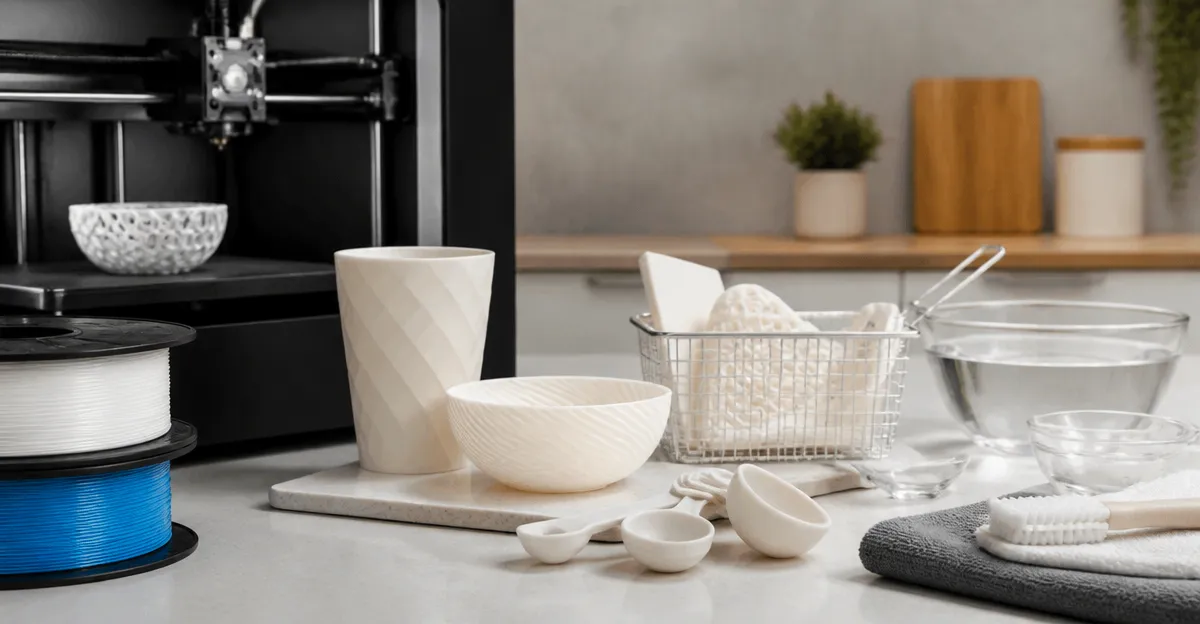
Food-Safe 3D Printing Guide: Best Filaments, Finishing Methods & Safety Tips
Introduction
This guide explains how to produce food‑contact parts with 3D printing technology while maintaining hygiene and regulatory compliance. Readers will learn the science behind food‑safe materials, how to select appropriate filaments, which post‑processing methods create reliable barriers, and practical safety habits for both home and professional environments.
We also highlight specific products that meet food‑safety criteria, providing real‑world performance data such as price, rating, and key specifications. By the end of the article, you will be equipped to make informed purchasing decisions and to print functional, safe components for kitchen tools, prototype molds, or medical devices.
Background/Context
Food‑safe 3D printing requires an understanding of material chemistry, extrusion temperature limits, and surface treatment options. Most consumer‑grade filaments are designed for visual quality rather than direct food contact, and they may contain additives that can leach under heat or moisture.
Regulatory bodies such as the U.S. Food and Drug Administration (FDA) classify materials as "food contact safe" when they meet specific migration limits. In practice, the safest approach is to use filaments explicitly marketed as food‑grade or to apply a certified coating after printing.
In addition, the printing environment—printer nozzle material, extruder temperature stability, and storage humidity—affects the final part’s safety profile. Proper filament handling and printer maintenance are therefore essential components of a comprehensive safety strategy.
Understanding Food Safety in 3D Printing
Food safety revolves around three core concepts: material purity, surface finish, and contamination control. Purity refers to the absence of harmful plasticizers, dyes, or metal fillers. Surface finish influences bacterial adhesion; smoother surfaces reduce microbial harborage. Contamination control includes preventing cross‑contamination from the printer’s hotend, build plate, or surrounding environment.
When selecting a filament, verify that the manufacturer provides a food‑grade certification or at least a statement that the polymer is free of toxic additives. PLA (polylactic acid) derived from corn starch is often considered the most benign, but not all PLA formulations are equal. PETG (glycol‑modified PET) offers higher temperature resistance and chemical durability, making it suitable for items that will encounter hot liquids.
Beyond the raw material, consider the printing temperature range. Excessive heat can cause degradation, releasing volatile organic compounds (VOCs). Maintaining nozzle temperatures within the filament’s recommended window preserves material integrity and minimizes off‑gassing.
Finally, post‑processing steps such as sanding, sealing, or applying food‑grade epoxy create a barrier that prevents micro‑cracks and reduces porosity, further limiting bacterial growth.
Choosing Food‑Safe Filaments
Below are four filaments that combine reliable printing performance with characteristics that support food‑safe applications. Each product is linked on first mention, and key specifications are highlighted.
- AMOLEN Silk Dual Color PLA – A 1.75 mm silk‑finished PLA bundle offering vibrant colors and a tolerance of ±0.02 mm. Priced at $27.99 for four 200 g spools, it holds a 4.3‑star rating from 6,727 reviewers. The filament’s smooth feeding and low warping make it suitable for decorative food‑contact items such as cookie cutters or cake toppers, provided a food‑grade seal is applied.
- SUNLU Black PLA – A 1 kg spool of black PLA with a 4.4‑star rating from 11,285 reviews, priced at $13.99. Its neat winding reduces tangles, and the dimensional accuracy of ±0.02 mm ensures consistent extrusion. While not marketed as food‑grade, its pure PLA composition can be safely used after a food‑compatible coating.
- Creality Black & White PLA Bundle – Two 1 kg spools (black and white) for $24.99, rated 4.5 stars by 7,788 users. The filament’s patented design promises clog‑free printing and strong inter‑layer bonding, useful for functional prototypes that later receive a food‑safe seal.
- ELEGOO Black PETG – A 1 kg PETG filament priced at $12.79 with an outstanding 4.9‑star rating from 19 reviewers. PETG’s higher heat resistance (up to 80 °C) and chemical stability make it a top choice for items that will encounter hot soups or sauces, especially after applying a food‑grade epoxy.
- SUNLU PLA Filament Bundle – An eight‑color assortment of 250 g spools totaling 2 kg for $41.99, rated 4.3 stars by 2,273 reviewers. The small spools reduce waste and support multi‑color prototypes; the filament’s low warping and high purity are advantageous for decorative kitchen accessories.
When evaluating these options, prioritize filaments that list a food‑grade certification or have a simple PLA composition without colorants that could leach. PETG, as offered by ELEGOO, inherently provides better barrier properties, making it the preferred material for items that will be exposed to higher temperatures.
Finishing Methods for Food‑Contact Parts
Printing alone rarely yields a surface smooth enough for direct food contact. The following finishing techniques transform raw prints into hygienic components.
- Sanding and Polishing: Begin with coarse grit (200) and progress to fine grit (2000) to achieve a glossy surface. Use water‑soluble lubricants to avoid embedding particles.
- Food‑Grade Sealants: Apply FDA‑approved epoxy or polyurethane coatings. These create an impermeable layer that prevents bacterial ingress and protects against moisture absorption.
- Acetone Vapor Smoothing (for ABS only): While not applicable to PLA or PETG, this method can be used on ABS parts that are later coated with a food‑safe sealant.
- Ultrasonic Cleaning: After sanding, place the part in an ultrasonic bath with a mild detergent to remove residual dust before sealing.
- Heat‑Treatment: For PETG, a low‑temperature bake (80 °C for 30 minutes) can reduce internal stresses and improve dimensional stability.
For decorative items printed with AMOLEN Silk Dual Color PLA, a clear food‑grade epoxy preserves the vibrant color while providing a safe surface. When using ELEGOO Black PETG, a simple silicone‑based sealant is often sufficient because PETG’s intrinsic barrier properties already limit moisture uptake.
Safety Tips for Printing and Post‑Processing
Adhering to safety protocols protects both the user and the final product. Follow these guidelines:
- Print in a well‑ventilated area; even PLA can emit faint odors at high temperatures.
- Store filaments in airtight containers with desiccant packs to prevent moisture absorption, which can cause bubbling and degrade food safety.
- Never reuse a nozzle that has been in contact with non‑food‑grade materials without thorough cleaning.
- Use dedicated tools (tweezers, brushes) for food‑grade prints to avoid cross‑contamination.
- Validate the final part’s surface roughness (Ra < 0.8 µm) before applying any sealant; rough surfaces harbor bacteria.
Regularly inspect the printer’s hotend for wear, as degraded PTFE liners can release particles that compromise food safety. When printing with SUNLU Black PLA or Creality Black & White PLA Bundle, keep the build plate clean and consider using a disposable PEI sheet to simplify cleaning.
Comparison / Selection Guide
| Filament | Material | Price (USD) | Rating | Key Food‑Safe Feature | Best Use Case |
|---|---|---|---|---|---|
| AMOLEN Silk Dual Color PLA | PLA (silk finish) | 27.99 | 4.3/5 (6,727) | Low warping, smooth surface, suitable for decorative food items after sealing | Cookie cutters, cake toppers, colorful kitchen accessories |
| SUNLU Black PLA | PLA | 13.99 | 4.4/5 (11,285) | Neatly wound, consistent diameter, easy to coat | Simple functional parts, prototype housings |
| Creality Black & White PLA Bundle | PLA | 24.99 | 4.5/5 (7,788) | Patented low‑clog design, strong inter‑layer bonding | Dual‑color functional prototypes, educational kits |
| ELEGOO Black PETG | PETG | 12.79 | 4.9/5 (19) | High temperature resistance, chemical durability, low moisture absorption | Hot‑food containers, reusable bottle caps, outdoor tools |
| SUNLU PLA Filament Bundle | PLA (multicolor) | 41.99 | 4.3/5 (2,273) | Small 250 g spools reduce waste, vibrant palette for decorative items | Multi‑color kitchen décor, educational projects |
For most food‑contact applications, PETG provides the strongest barrier against heat and moisture, making ELEGOO Black PETG the top recommendation. When visual appeal is paramount and the part will be sealed, AMOLEN Silk Dual Color PLA offers an attractive finish without compromising print reliability.
Best Practices & Tips
- Calibrate your printer’s extrusion multiplier for each filament batch; a 2‑3% adjustment often eliminates under‑extrusion that can create micro‑gaps.
- Print at the lower end of the recommended temperature range to reduce thermal degradation while maintaining layer adhesion.
- Use a heated bed (50‑65 °C for PLA, 70‑80 °C for PETG) to minimize warping, which can lead to uneven surfaces.
- After printing, immediately cool the part on a non‑porous surface to prevent moisture condensation.
- Document the printing parameters (temperature, speed, fan settings) for each filament type; this data aids regulatory documentation if the part is intended for commercial food use.
Frequently Asked Questions
- 1. Is PLA considered food‑safe by default?
- Pure PLA without additives is generally regarded as low‑risk, but most manufacturers do not certify it for direct food contact. Applying a food‑grade sealant is recommended.
- 2. Can I use a standard 3D printer nozzle for PETG?
- Yes, but a hardened steel nozzle prolongs life because PETG can be more abrasive than PLA. Ensure the nozzle temperature does not exceed the filament’s maximum (typically 250 °C).
- 3. How do I store filaments to maintain food‑safety?
- Keep filaments in airtight containers with desiccant packs. For long‑term storage, consider vacuum‑sealed bags to prevent moisture uptake and microbial growth.
- 4. Do I need a separate printer for food‑grade prints?
- While a dedicated printer eliminates cross‑contamination, thorough cleaning of a shared printer (nozzle, bed, extruder) can achieve comparable safety if documented procedures are followed.
- 5. What sealants are truly food‑grade?
- Look for FDA‑certified epoxy such as “FoodSafe Epoxy” or silicone coatings labeled “NSF‑51”. Verify that the product’s technical data sheet lists compliance with 21 CFR 175.300.
- 6. Is there a difference between food‑safe and food‑contact‑approved?
- Food‑safe generally implies the material will not leach harmful substances under normal use, whereas food‑contact‑approved indicates formal regulatory approval. For commercial products, seek the latter.
Conclusion
Food‑safe 3D printing merges material science, precise printing techniques, and diligent post‑processing to produce hygienic parts suitable for culinary and medical contexts. By selecting appropriate filaments—such as PLA bundles from AMOLEN or PETG from ELEGOO—and applying thorough finishing methods, creators can ensure safety without sacrificing design freedom.
Remember to maintain a clean printing environment, store filaments properly, and document every step. These practices not only protect end‑users but also simplify compliance with food‑safety regulations.
Products Featured in This Guide
AMOLEN Silk Dual Color PLA
Price: $27.99 | Rating: 4.3/5 (6,727 reviews)
Featured for its vibrant color palette, smooth feeding, and low warping, making it ideal for decorative food‑contact prototypes after sealing.
SUNLU Black PLA
Price: $13.99 | Rating: 4.4/5 (11,285 reviews)
Highlighted for its neat winding, consistent diameter, and affordability, suitable for functional parts that can be coated with a food‑grade sealant.
Creality Black & White PLA Bundle
Price: $24.99 | Rating: 4.5/5 (7,788 reviews)
Chosen for its dual‑color offering, low‑clog design, and strong inter‑layer adhesion, useful for prototype parts that require a food‑safe coating.
ELEGOO Black PETG
Price: $12.79 | Rating: 4.9/5 (19 reviews)
Featured for its high temperature resistance, chemical durability, and glossy finish, making it the premier choice for hot‑food containers after sealing.
SUNLU PLA Filament Bundle
Price: $41.99 | Rating: 4.3/5 (2,273 reviews)
Included for its multi‑color mini spools that reduce waste and enable vibrant decorative prints, ideal for colorful kitchen accessories after proper sealing.