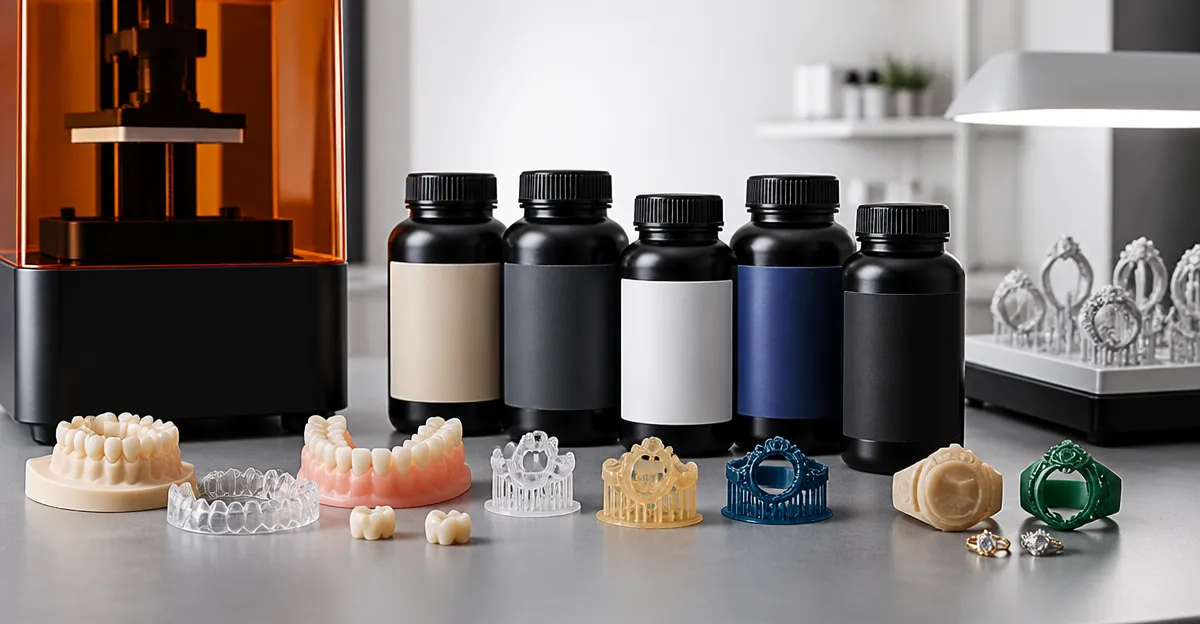
Best Resins for Dental & Jewelry 3D Printing: The Ultimate Guide to Materials, Selection, and Post‑Processing
Introduction
Three‑dimensional printing has transformed the production of dental appliances and fine jewelry by enabling rapid prototyping and low‑volume manufacturing. This guide explains the essential properties of photopolymer resins, outlines how to evaluate them, and recommends specific products that excel in accuracy, strength, and finish. Readers will learn the science behind resin curing, the criteria for selecting the optimal material, and best‑practice post‑processing techniques that ensure professional results.
The information presented is based on real‑world performance data, customer feedback, and technical specifications from leading manufacturers. By the end of the article, one will be able to match resin characteristics to the demands of dental crowns, orthodontic models, intricate rings, and detailed pendants.
Background and Context
Resin‑based stereolithography (SLA) and digital light processing (DLP) printers use a liquid photopolymer that solidifies when exposed to a specific wavelength of ultraviolet (UV) light, typically 405 nm. The polymerization process creates layers of cured material that stack to form the final object. The quality of the final part depends on resin viscosity, shrinkage, hardness, and post‑cure stability.
In dental applications, dimensional accuracy within 50 µm is often required to ensure proper fit of crowns, bridges, and aligner trays. For jewelry, surface smoothness, high resolution of fine details, and the ability to polish or cast are critical. Selecting a resin that balances low shrinkage, high tensile strength, and appropriate hardness is therefore essential.
Manufacturers formulate resins for different performance targets. "ABS‑like" formulations aim to mimic the toughness of acrylonitrile‑butadiene‑styrene (ABS) plastic, providing impact resistance and the ability to drill or sand without fracturing. Standard resins focus on clarity and fine detail, making them suitable for aesthetic pieces. Each formulation also varies in odor, curing speed, and compatibility with specific printer models.
Key Concepts for Resin Selection
When evaluating a resin for dental or jewelry use, consider the following criteria:
- Mechanical Strength: Tensile and impact resistance determine whether a printed crown can withstand occlusal forces or a ring can endure daily wear.
- Dimensional Stability: Low volumetric shrinkage preserves the designed geometry after curing, reducing the need for manual compensation.
- Surface Finish: Smooth, low‑layer‑line surfaces reduce post‑processing time for polishing or casting.
- Curing Speed: Faster cure times increase throughput but may require precise exposure settings to avoid over‑curing.
- Odor and Safety: Low‑VOC formulations improve the working environment, especially in dental labs where ventilation may be limited.
Understanding these concepts allows one to align material properties with the functional requirements of the final product.
Recommended Resins for Dental & Jewelry Applications
Below are four resins that meet the stringent demands of dental and jewelry printing. The first mention of each product includes a clickable link that opens in a new tab.
1. ELEGOO ABS-Like 3.0 Resin
This formulation offers high strength and toughness, making it ideal for functional dental prototypes such as surgical guides and for jewelry pieces that require durability during handling. The resin’s low viscosity (25‑47 % lower than earlier versions) promotes rapid flow back into the vat, reducing print failures. With a rating of 4.7/5 from 1,079 reviews, users praise its impact resistance and smooth surface finish. The 2000 g bottle is priced at $29.99, providing a cost‑effective solution for high‑volume labs.
Key specifications include high precision with low shrinkage, strong stability that prevents delamination, and compatibility with most 405 nm LCD/DLP printers. The resin can be drilled or sanded after post‑cure, a valuable trait for adjusting dental models or customizing jewelry settings.
2. ANYCUBIC Gray Resin
This resin balances affordability with reliable performance. Priced at $14.99 for a 1 kg bottle, it delivers low shrinkage and high precision, which are essential for accurate dental models and fine‑detail jewelry components. The product holds a 4.7/5 rating from over 10,000 reviews, indicating broad user satisfaction.
Its quick curing and strong stability in moist environments make it suitable for post‑cure polishing and casting workflows. The resin’s rigidity and toughness also allow for easy removal of supports without damaging delicate features.
3. ELEGOO Standard Resin
For projects that prioritize fine detail and vivid color, the ELEGOO Standard Resin is an excellent choice. At $15.99 per kilogram, it offers low shrinkage, fast curing, and a bright gray pigment that can be easily painted or dyed after post‑processing. The resin has a 4.7/5 rating from 10,043 reviewers, many of whom note its smooth surface and ease of cleaning with isopropyl alcohol.
This formulation works well for dental study models, temporary prosthetics, and jewelry prototypes where high resolution and aesthetic appeal are paramount.
4. ELEGOO ABS-Like 3.0+ Resin
The 3.0+ version raises the heat‑resistance threshold to 55 °C, which can be advantageous for dental appliances that may be exposed to warm environments during sterilization. With a rating of 4.8/5 from 524 reviews, users commend its fast curing, excellent fluidity, and superior impact resistance.
Its high precision and low shrinkage ensure that intricate jewelry settings retain their designed dimensions, while the resin’s ability to be sanded and painted supports downstream finishing processes.
5. ANYCUBIC ABS-Like Resin Pro 2
This resin emphasizes both strength and low odor, a combination that benefits dental laboratories with strict ventilation requirements. Priced at $15.99 for 1 kg, it achieves an elongation at break of up to 40 %, providing exceptional toughness for functional dental parts and durable jewelry components. The product holds a 4.8/5 rating from 516 reviews, with users highlighting its high fluidity and consistent curing.
Its low viscosity reduces the risk of delamination, and the reduced smell makes it pleasant for extended printing sessions in confined spaces.
Comparison and Selection Guide
The table below summarizes the most relevant attributes for each resin, allowing readers to compare them side by side.
| Resin | Price (per 1 kg) | Rating | Strength | Shrinkage | Odor | Best For |
|---|---|---|---|---|---|---|
| ELEGOO ABS-Like 3.0 | $29.99 (2000 g) | 4.7 | High | Low | Moderate | Functional dental prototypes, durable jewelry |
| ANYCUBIC Gray | $14.99 | 4.7 | Medium | Low | Low | Cost‑effective models, quick turnaround |
| ELEGOO Standard | $15.99 | 4.7 | Medium | Low | Moderate | High‑detail aesthetic pieces, study models |
| ELEGOO ABS-Like 3.0+ | $29.99 (2000 g) | 4.8 | Very High | Very Low | Moderate | Heat‑exposed dental parts, premium jewelry |
| ANYCUBIC ABS-Like Pro 2 | $15.99 | 4.8 | Very High | Very Low | Low | Low‑odor environments, high‑toughness applications |
For dental labs that prioritize mechanical strength and heat resistance, the ELEGOO ABS-Like 3.0+ Resin stands out. For jewelry designers seeking fine detail at a modest price, the ELEGOO Standard Resin offers excellent resolution. When budget constraints dominate, ANYCUBIC Gray Resin provides reliable performance without sacrificing accuracy.
Best Practices & Tips for Dental and Jewelry 3D Printing
Even the best resin will underperform without proper handling. Follow these guidelines to achieve consistent, high‑quality results.
- Maintain Proper Viscosity: Store resin at the recommended temperature (typically 20‑25 °C) to avoid excessive thickening. Stir the bottle gently before each use to ensure uniform pigment distribution.
- Calibrate Exposure Settings: Start with the manufacturer’s recommended exposure time, then adjust in 5‑10 % increments based on test prints. Over‑exposure can cause loss of detail, while under‑exposure leads to weak layer adhesion. li>Use Supports Wisely: For dental models, place supports away from occlusal surfaces to minimize post‑processing. In jewelry, use thin, easily removable supports to preserve delicate filigree.
- Post‑Cure Thoroughly: After washing prints in isopropyl alcohol, expose them to a UV chamber for the recommended duration (usually 2‑5 minutes per side). Proper post‑cure maximizes hardness and reduces residual monomer release.
- Polish and Cast: For jewelry, sand the cured piece with progressively finer grits, then apply a clear coat or invest for metal casting. For dental appliances, verify fit with a silicone index before final finishing.
- Ventilation and Safety: Even low‑odor resins emit volatile organic compounds (VOCs). Operate in a well‑ventilated area and wear nitrile gloves and safety glasses.
Frequently Asked Questions
1. Which resin provides the lowest shrinkage for precise dental models?
Both the ELEGOO ABS-Like 3.0+ Resin and the ANYCUBIC ABS-Like Pro 2 Resin advertise very low shrinkage rates, making them suitable for high‑precision dental applications.
2. Can I use a standard resin for metal casting of jewelry?
Yes, standard resins such as ELEGOO Standard Resin produce fine details that can be invested and cast in metal, provided the printed part is fully cured and cleaned.
3. How does odor affect the printing environment?
Resins with low‑VOC formulations, such as ANYCUBIC ABS-Like Pro 2, emit less odor and are more comfortable for extended use in enclosed labs.
4. Is a higher price always indicative of better performance?
Not necessarily. While premium resins often deliver specialized properties like heat resistance, a mid‑range resin such as ANYCUBIC Gray Resin may meet the requirements of many dental and jewelry projects at a lower cost.
5. What safety precautions are recommended when handling resins?
Always wear nitrile gloves, eye protection, and work in a well‑ventilated area. Dispose of waste resin according to local regulations and avoid direct skin contact.
Conclusion
Choosing the appropriate resin is a critical step in producing reliable dental appliances and exquisite jewelry pieces. By understanding mechanical strength, shrinkage, curing speed, and odor, professionals can match material properties to the functional and aesthetic demands of each project. The recommended resins—ELEGOO ABS-Like 3.0, ANYCUBIC Gray, ELEGOO Standard, ELEGOO ABS-Like 3.0+, and ANYCUBIC ABS-Like Pro 2—cover a spectrum of performance levels and price points, ensuring that both budget‑conscious and high‑end users find a suitable option.
Implementing the best‑practice guidelines for handling, exposure calibration, and post‑processing will further enhance the quality and durability of printed parts. Whether creating a precise orthodontic aligner or a delicate gemstone setting, the right resin combined with disciplined workflow results in superior outcomes.
Products Featured in This Guide
ELEGOO ABS-Like 3.0 Resin
Price: $29.99 (2000 g) | Rating: 4.7/5 (1,079 reviews)
Featured for its high strength, low viscosity, and excellent dimensional stability, making it ideal for functional dental prototypes and durable jewelry components.
ANYCUBIC Gray Resin
Price: $14.99 (1 kg) | Rating: 4.7/5 (10,412 reviews)
Featured for its affordability, low shrinkage, and high precision, suitable for cost‑effective dental models and fine‑detail jewelry prints.
ELEGOO Standard Resin
Price: $15.99 (1 kg) | Rating: 4.7/5 (10,043 reviews)
Featured for its bright color, fast curing, and low shrinkage, ideal for high‑resolution dental study models and aesthetic jewelry prototypes.
ELEGOO ABS-Like 3.0+ Resin
Price: $29.99 (2000 g) | Rating: 4.8/5 (524 reviews)
Featured for its elevated heat resistance and superior impact strength, making it suitable for heat‑exposed dental parts and premium jewelry applications.
ANYCUBIC ABS-Like Resin Pro 2
Price: $15.99 (1 kg) | Rating: 4.8/5 (516 reviews)
Featured for its high elongation at break, low odor, and excellent fluidity, providing a durable, pleasant‑to‑use option for both dental and jewelry printing.