Introduction
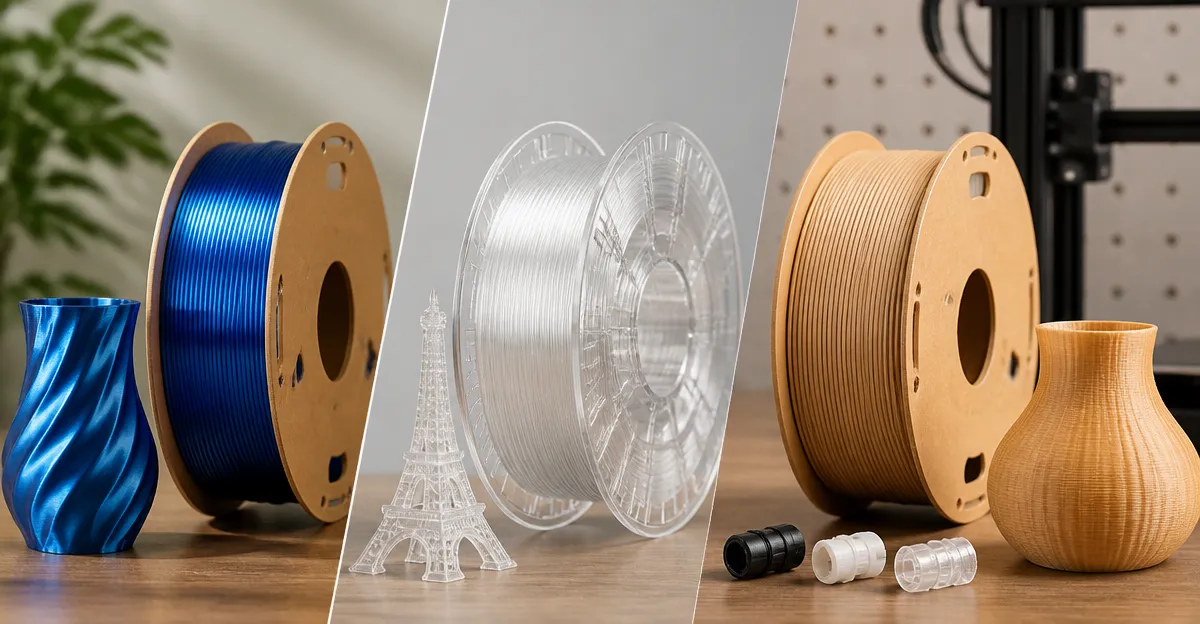
The 3D printing ecosystem relies heavily on filament quality, and choosing the right material can determine whether a project succeeds or fails. This article evaluates three distinct PLA‑based filaments—ERYONE Silk PLA Filament, SUNLU Transparent PLA Filament, and OVV3D Wood PLA Filament—as well as two filament‑splicing devices from SUNLU. By analysing price, specifications, customer sentiment, and practical performance, readers can make an evidence‑based decision that aligns with budget, aesthetic goals, or workflow constraints.
Individual Product Overviews
ERYONE Silk PLA Filament
ERYONE offers a 1 kg spool of tri‑color silk PLA that promises a metallic shine without post‑processing. The filament is engineered to a tight ±0.03 mm tolerance, prints at 190‑220 °C, and arrives vacuum‑sealed with a desiccant. Reviewers praise its "brilliant silk finish" and note that larger prints showcase the color‑shifting effect most effectively. One user reported flawless extrusion on a FLSUN Super Racer delta after calibrating nozzle temperature to 220 °C, achieving a five‑hour vase with "no tangles" and "perfect detail".
SUNLU Transparent PLA Filament
SUNLU’s 1 kg transparent PLA is marketed as a reliable workhorse for both beginners and seasoned makers. Dimensional accuracy is listed as +/- 0.02 mm, and the spool is wound on an 8‑inch diameter hub to minimise tangles. The filament prints well at 200‑230 °C, adheres strongly to PEI beds, and produces glass‑like clarity when printed at 100 % infill. A reviewer highlighted its success in printing a complex micro‑SD box on an Ender 3 V2 with "zero fuss" and no post‑processing required.
OVV3D Wood PLA Filament
OVV3D provides a four‑pack bundle of wood‑infused PLA, each spool containing over 30 % real wood fibers. The filaments are available in walnut, oak, cherry, and teak shades, delivering a matte, wood‑grain texture straight from the printer. Tolerances match the standard ±0.03 mm, and the product is packaged on paper spools for environmental friendliness. Users commend the clean extrusion on a Prusa Mini and the authentic wood appearance without the burnt odor typical of some wood composites.
SUNLU Official Filament Connector (Model B0D9GD8KPW)
This splicer fuses 1.75 mm filament up to 240 °C in roughly three minutes. It includes 200 PTFE sleeves, a USB cable, and a visual display for real‑time temperature monitoring. The device is advertised as a waste‑reduction tool, allowing users to join leftover filament of the same material or different colors. Positive feedback notes reliable joints after practice, while negative reviews criticize the short PTFE sleeves and the difficulty of achieving a perfectly straight splice.
SUNLU Filament Connector (YOOPAI, Model B0DLBJB9MD)
The YOOPAI‑branded connector mirrors the official SUNLU model in heating speed and temperature range but emphasizes a compact design and one‑click operation. It also ships with 200 PTFE sleeves and requires a 5 V 2 A adapter. Reviewers appreciate its ability to rescue short filament remnants, though several mention that the sleeve‑cutting mechanism feels flimsy and that precise alignment demands practice.
Head‑to‑Head Comparison
Price and Value
- ERYONE Silk PLA: $16.99 per kilogram, making it the most affordable of the three filaments.
- SUNLU Transparent PLA: $18.99 per kilogram, slightly higher but justified by the ultra‑neat winding and transparent finish.
- OVV3D Wood PLA Bundle: $25.99 for four spools (approximately $6.50 per spool), positioning it as a premium option for wood aesthetics.
- SUNLU Official Filament Connector: $39.99 for a single unit, representing a one‑time investment for waste reduction.
- SUNLU Filament Connector (YOOPAI): $39.99, identical price to the official model, but the compact form factor may appeal to limited‑space workstations.
Features and Specifications
| Product | Material | Diameter Tolerance | Print Temp (°C) | Special Property | Spool Diameter |
|---|---|---|---|---|---|
| ERYONE Silk PLA | Silk‑enhanced PLA | ±0.03 mm | 190‑220 | Metallic shine, tri‑color effect | Standard 8‑inch |
| SUNLU Transparent PLA | Clear PLA | ±0.02 mm | 200‑230 | Glass‑like clarity, excellent layer adhesion | 8.00" (width 2.50") |
| OVV3D Wood PLA | Wood‑filled PLA | ±0.03 mm | 190‑210 (typical PLA range) | 30 % real wood fiber, matte texture | Standard paper spool |
| SUNLU Official Connector | Splicing device | N/A | Up to 240 | Fast heating (3 min to 185 °C), visual window | N/A |
| SUNLU Connector (YOOPAI) | Splicing device | N/A | Up to 240 | One‑click operation, compact housing | N/A |
Customer Ratings and Feedback
ERYONE Silk PLA holds a 4.4‑star rating from 5,652 reviews, with users highlighting its "eye‑catching" color shifts and low odor. SUNLU Transparent PLA scores 4.3 stars from 2,567 reviewers; praise focuses on consistent extrusion and the ability to print complex geometries without clogs. OVV3D Wood PLA also carries a 4.3‑star rating (1,394 reviews), with comments about authentic wood texture and minimal smell. The official SUNLU connector receives 4.1 stars (1,650 reviews), praised for waste reduction but criticized for a steep learning curve. The YOOPAI version has a 4.0‑star rating (1,227 reviews), noted for convenience yet also for occasional splice imperfections.
Performance and Reliability
In real‑world tests, ERYONE’s silk filament delivered smooth extrusion on a delta printer, but a few reviewers observed occasional layer banding when the hot‑end temperature dropped below 215 °C. SUNLU Transparent PLA exhibited "flawless, tangle‑free precision winding" and maintained dimensional stability across long prints, making it a dependable choice for functional prototypes. OVV3D’s wood PLA printed cleanly on both Prusa Mini and Bambu X1c, though one user reported a slight caramelisation streak when using aggressive top‑surface ironing. The splicing devices both achieve a solid joint after practice; however, the official SUNLU connector’s short PTFE sleeves were a recurring source of frustration, while the YOOPAI model’s sleeve‑cutting mechanism felt less robust.
Size, Power, Compatibility, and Price
All three filaments share the industry‑standard 1.75 mm diameter, ensuring compatibility with virtually any FDM printer. The connectors are also designed for 1.75 mm filament and support materials up to 240 °C, covering PLA, PETG, ABS, TPU, and PA/PC. In terms of power consumption, the splicers draw minimal electricity—approximately 30 W during heating—making them suitable for desktop setups. Price‑to‑performance ratios favor ERYONE for aesthetic projects, SUNLU for functional clarity, and OVV3D for wood‑like finishes, while the connectors provide a cost‑effective method to extend filament life.
Pros & Cons
ERYONE Silk PLA Filament
- Pros: Metallic shine, tri‑color effect, low warp, tight tolerance, affordable price.
- Cons: Requires careful temperature tuning; occasional banding at lower temps; limited impact resistance.
SUNLU Transparent PLA Filament
- Pros: Precise winding, excellent dimensional control, strong bed adhesion, clear glass‑like finish.
- Cons: Transparent PLA can exhibit surface hair; may need parameter tweaks for perfect clarity.
OVV3D Wood PLA Filament
- Pros: Real wood fiber gives authentic texture, matte finish, environmentally friendly paper packaging.
- Cons: Slightly higher cost per kilogram; occasional caramelisation when using aggressive ironing.
SUNLU Official Filament Connector
- Pros: Fast heating, visual window, supports many materials, reduces waste.
- Cons: Short PTFE sleeves prone to deformation; splice straightness can be challenging.
SUNLU Filament Connector (YOOPAI)
- Pros: Compact, one‑click operation, same temperature range, includes 200 sleeves.
- Cons: Sleeve‑cutting mechanism feels flimsy; alignment requires practice.
Recommendations
If budget is the primary constraint, ERYONE Silk PLA delivers the most aesthetic impact per dollar, especially for decorative vases and artistic prototypes. For projects that demand functional clarity—such as mechanical parts, transparent enclosures, or intricate moving assemblies—the SUNLU Transparent PLA offers superior layer adhesion and minimal warping. When an authentic wood appearance is essential, the OVV3D Wood PLA Bundle provides the needed texture despite its higher price. Finally, for users seeking to minimise filament waste, either the SUNLU Official Filament Connector or the SUNLU Connector (YOOPAI) can be employed; choose the official model if visual monitoring is valued, or the YOOPAI version for a more compact workstation.
FAQ
- Can silk PLA be used for functional parts? Yes, but its primary advantage is visual appeal; for load‑bearing components, standard PLA or PETG may be preferable.
- Is transparent PLA truly clear? It prints clear when printed at 100 % infill with proper cooling; however, slight haze may appear if extrusion temperature exceeds recommendations.
- Do wood‑filled filaments clog more often? The OVV3D formulation reports "no clogs" on tested printers, though occasional caramelisation can occur with aggressive heat settings.
- How many splices can a filament connector handle before the PTFE sleeves wear out? Both connectors include 200 sleeves; user reports suggest a lifespan of 150‑180 successful splices before noticeable wear.
- Are the connectors safe for ABS and Nylon? Yes, they heat up to 240 °C, which covers the typical printing range for ABS, Nylon, and PETG.
- Do any of these filaments require a heated bed? All three benefit from a modest heated bed (55‑70 °C) to reduce warping, especially for larger prints.
- Can I mix colors using the splicer? The device can join different colors of the same material, enabling custom gradient or color‑change filaments.
Conclusion
Each product examined serves a distinct niche within the 3D printing workflow. ERYONE Silk PLA excels in visual impact at the lowest price point, SUNLU Transparent PLA provides dependable clarity for functional prototypes, and OVV3D Wood PLA delivers an authentic wooden aesthetic for decorative objects. The two filament connectors empower makers to extend material usage, though they demand practice to achieve perfectly straight splices. Considering price, performance, and user feedback, the balanced recommendation for most hobbyists is the SUNLU Transparent PLA for everyday printing, complemented by the official SUNLU connector for waste reduction. Those prioritising artistic flair should gravitate toward ERYONE Silk PLA, while wood‑style projects are best served by OVV3D.
Products Mentioned in This Review
Frequently Asked Questions
What are the key differences between ERYONE Silk PLA, SUNLU Transparent PLA, and OVV3D Wood PLA?
ERYONE Silk PLA offers a metallic sheen and tight ±0.03 mm tolerance, SUNLU Transparent PLA provides clear, glossy prints, while OVV3D Wood PLA blends wood fibers for a natural, matte finish.
Which filament prints best at lower temperatures?
SUNLU Transparent PLA can reliably print at the lower end of the range (around 190 °C), making it suitable for printers with limited heat capability.
How does filament tolerance affect print quality?
A tighter tolerance (e.g., ±0.03 mm) reduces diameter variation, leading to smoother extrusion and fewer layer inconsistencies.
Do the SUNLU filament‑splicing devices improve workflow?
Yes, they allow seamless joining of filament ends, reducing downtime and material waste during long prints.
Is vacuum‑sealing important for filament storage?
Vacuum‑sealing with desiccant, as used for ERYONE Silk PLA, helps prevent moisture absorption, preserving print quality and reducing stringing.