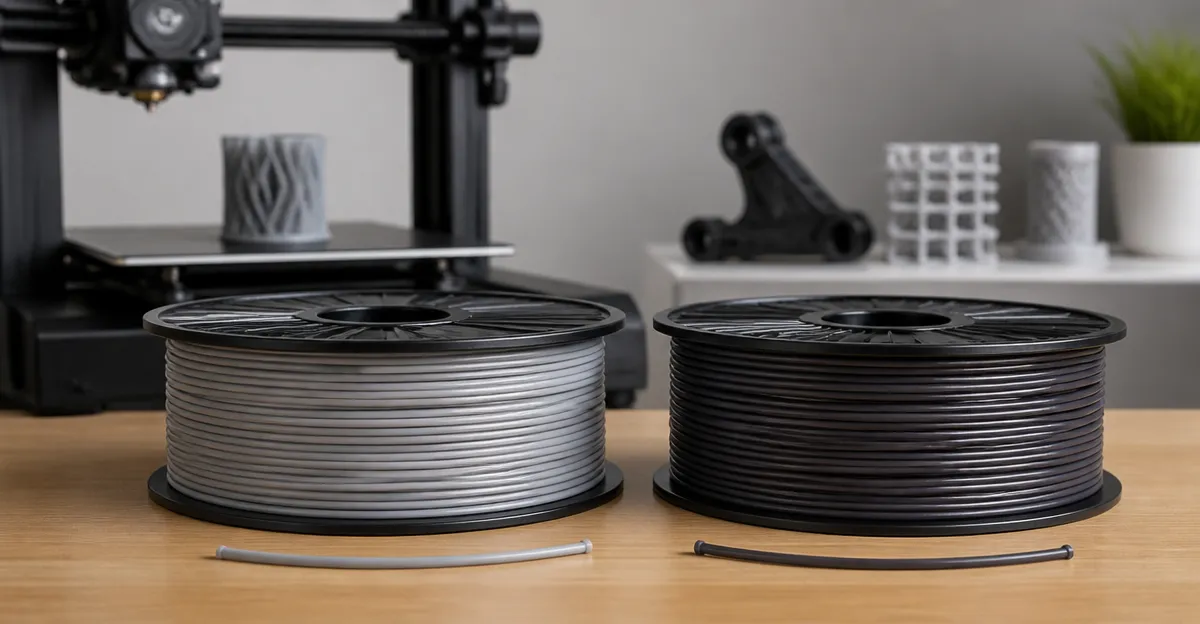
1.75mm vs 2.85mm Filament: Ultimate Guide to Printers That Support 2.85mm (Ultimaker, LulzBot, Prusa)
Introduction
This guide examines the technical distinctions between 1.75mm and 2.85mm filament diameters, clarifies which popular printer families natively support the larger format, and provides actionable advice for selecting the appropriate material. Readers will learn about mechanical properties, printer hardware considerations, and how to match filament characteristics to project requirements. The article also integrates real‑world product examples to illustrate best‑in‑class options for both ABS and PLA families.
Background and Context
Filament diameter influences extrusion consistency, heat transfer, and the mechanical design of the extruder. The 1.75mm standard emerged from hobbyist printers seeking faster acceleration and lower inertia, while the 2.85mm (often marketed as 3mm) format originated in industrial‑grade machines where higher melt flow rates are advantageous. Both diameters are compatible with fused deposition modeling (FDM) technology, yet each imposes distinct requirements on feeder gears, hot‑end geometry, and slicer settings.
Key technical concepts include:
- Tolerance: Precise diameter control (+/- 0.02mm for most premium filaments) prevents under‑extrusion and filament jamming.
- Thermal mass: Larger diameter filaments retain more heat, enabling higher printing speeds for robust thermoplastics such as ABS.
- Compatibility matrix: Manufacturers such as Ultimaker, LulzBot, and Prusa produce models that accept both diameters, though many Prusa printers are optimized for 1.75mm.
Material Choices for 2.85mm Filament
When selecting a filament for a 2.85mm printer, the primary decision revolves around polymer type. ABS provides superior impact resistance and heat tolerance, making it suitable for functional prototypes and end‑use parts. PLA, derived from renewable resources, offers ease of use, minimal warping, and a lower printing temperature.
Among the available options, the following products exemplify the strengths of each material family:
- Gizmo Dorks Black ABS Filament – a high‑impact, heat‑resistant ABS spool rated 4.4/5 from 392 reviews. It features ultra‑tight tolerances (+/- 0.02mm) and is compatible with LulzBot, Ultimaker, and Airwolf 3D printers.
- Gizmo Dorks 4-Color PLA Filament Set – an 800g multi‑color pack of PLA that delivers low warping and odorless printing, ideal for prototyping and visual testing.
- CC3D Rainbow PLA Filament – a silk‑finished, multicolor gradient PLA that provides a decorative finish without post‑processing.
- Gizmo Dorks Glow Blue ABS Filament – a low‑odor ABS formulation that emits a blue glow in darkness, combining strength with visual novelty.
- Gizmo Dorks White PLA Filament – a 1kg white PLA spool offering crisp detail and reliable dimensional accuracy for display models.
Each filament adheres to the industry‑standard 2.85mm tolerance, ensuring reliable feeding across the highlighted printer families.
Printer Compatibility Overview
The following table summarises the native support for 2.85mm filament among major printer brands:
| Printer Brand | Model Examples | Supported Diameters | Notable Features |
|---|---|---|---|
| Ultimaker | Ultimaker S5, Ultimaker 3 | 2.85mm (primary), 1.75mm (optional) | Dual extrusion, heated enclosure, large build volume. |
| LulzBot | LulzBot TAZ 6, LulzBot Mini 2 | 2.85mm (primary), 1.75mm (optional) | Open‑source hardware, interchangeable tool heads. |
| Prusa | Original Prusa i3 MK3S+ (with upgrade) | 1.75mm (standard) – 2.85mm possible via hot‑end swap. | Highly reliable, community‑driven firmware. |
When a printer supports both diameters, the decision often hinges on the desired print speed and material viscosity. Larger diameter filaments allow higher extrusion rates, which can reduce overall print time for bulky parts.
Comparison and Selection Guide
To assist readers in choosing the appropriate filament, the guide presents a side‑by‑side comparison of the featured products based on key criteria:
| Criterion | Gizmo Dorks Black ABS | Gizmo Dorks 4‑Color PLA Set | CC3D Rainbow PLA | Gizmo Dorks Glow Blue ABS | Gizmo Dorks White PLA |
|---|---|---|---|---|---|
| Material Type | ABS | PLA | PLA (silk finish) | ABS (low odor) | PLA |
| Spool Weight | 1 kg | 200 g each (800 g total) | 1 kg | 1 kg | 1 kg |
| Price (USD) | 20.95 | 24.95 | 16.99 | 24.95 | 23.95 |
| Average Rating | 4.4/5 (392 reviews) | 4.3/5 (180 reviews) | 4.3/5 (138 reviews) | 4.3/5 (51 reviews) | 4.2/5 (362 reviews) |
| Special Feature | High‑impact, heat‑resistant | Four vibrant colors for multi‑color prints | Rainbow gradient, no post‑processing needed | Glow‑in‑the‑dark, low odor | Crisp detail, smooth finish |
For functional prototypes that require impact resistance, the Black ABS filament is the optimal choice. For visual projects where color variety or aesthetic finish is paramount, the 4‑Color PLA Set or the Rainbow PLA provide distinct advantages.
Best Practices and Tips for 2.85mm Filament
- Calibrate Extruder Steps: Because 2.85mm filament has a larger cross‑section, verify that the extruder steps per millimeter are correctly set in the firmware.
- Maintain Consistent Temperature: ABS filaments such as Black ABS and Glow Blue ABS perform best within a 225‑250 °C nozzle range, while PLA variants print comfortably between 190‑220 °C.
- Use a Heated Bed: For ABS, a heated bed of 80‑110 °C prevents warping; PLA generally adheres well on a 50‑60 °C bed but can also print on an unheated surface.
- Control Print Speed: Larger diameter filaments benefit from moderate speeds (30‑60 mm/s). Reducing speed improves layer adhesion, especially for the silk‑finish CC3D Rainbow PLA.
- Post‑Processing Considerations: ABS parts can be smoothed with acetone vapor for a glossy finish, while PLA parts can be sanded and painted without chemical treatment.
- Storage: Keep filaments in airtight containers with desiccant packs to avoid moisture absorption, which can cause bubbling and poor surface quality.
Frequently Asked Questions
- 1. Can I use 2.85mm filament in a printer that was originally shipped with 1.75mm?
- Yes, provided the printer allows a hot‑end swap or offers a dual‑diameter extruder. Many Ultimaker and LulzBot models include interchangeable nozzles that support both sizes.
- 2. Is ABS always more difficult to print than PLA?
- ABS requires a heated bed and preferably an enclosed build chamber to minimise warping. Low‑odor formulations such as Gizmo Dorks Glow Blue ABS Filament mitigate odor but still demand temperature control.
- 3. What are the advantages of a 2.85mm filament for large prints?
- The larger diameter delivers higher melt flow, enabling faster extrusion rates and reduced print times for voluminous parts without sacrificing dimensional accuracy.
- 4. How does filament tolerance affect print quality?
- Tighter tolerances (+/- 0.02mm) ensure consistent extrusion, reducing the risk of under‑extrusion, stringing, and layer inconsistencies. All featured products meet this standard.
- 5. Can I achieve a glossy finish without post‑processing? dd>Silk‑finish PLA such as CC3D Rainbow PLA Filament produces a naturally shiny surface, eliminating the need for additional polishing.
- 6. Is multi‑color printing possible with a single extruder?
- Yes, by swapping spools manually or using a filament switcher. The Gizmo Dorks 4-Color PLA Filament Set simplifies this process with four distinct colors.
- 7. Does filament color affect mechanical properties?
- Color pigments can slightly alter thermal conductivity and strength, but differences are typically marginal for standard engineering applications.
Conclusion
Understanding the interplay between filament diameter, material properties, and printer capabilities empowers users to optimise both print speed and part performance. While 1.75mm filament remains popular for its low inertia, 2.85mm filament offers superior melt flow for demanding thermoplastics such as ABS. By selecting the appropriate filament—whether the high‑impact Black ABS, the versatile 4‑Color PLA set, or the decorative Rainbow PLA—users can achieve reliable, high‑quality results on Ultimaker, LulzBot, and compatible Prusa machines.
Adhering to best‑practice guidelines, maintaining proper temperature regimes, and storing filament correctly will further enhance outcomes. The featured products provide a curated selection that addresses a range of functional and aesthetic needs, allowing makers to focus on design rather than material uncertainty.
Products Featured in This Guide
Gizmo Dorks Black ABS Filament
Price: $20.95 | Rating: 4.4/5 (392 reviews)
Featured for its high‑impact, heat‑resistant ABS formulation and ultra‑tight tolerances, making it ideal for functional prototypes on 2.85mm printers.
Gizmo Dorks 4-Color PLA Filament Set
Price: $24.95 | Rating: 4.3/5 (180 reviews)
Featured for providing four vibrant PLA colors in a convenient 800g total, supporting multi‑color testing and small‑scale builds.
CC3D Rainbow PLA Filament
Price: $16.99 | Rating: 4.3/5 (138 reviews)
Featured for its silk‑finish rainbow gradient that delivers a decorative, glossy surface without additional polishing.
Gizmo Dorks Glow Blue ABS Filament
Price: $24.95 | Rating: 4.3/5 (51 reviews)
Featured for its low‑odor formulation and glow‑in‑the‑dark property, offering both mechanical strength and visual novelty.
Gizmo Dorks White PLA Filament
Price: $23.95 | Rating: 4.2/5 (362 reviews)
Featured for its crisp detail and reliable dimensional accuracy, suitable for display models and architectural prototypes.