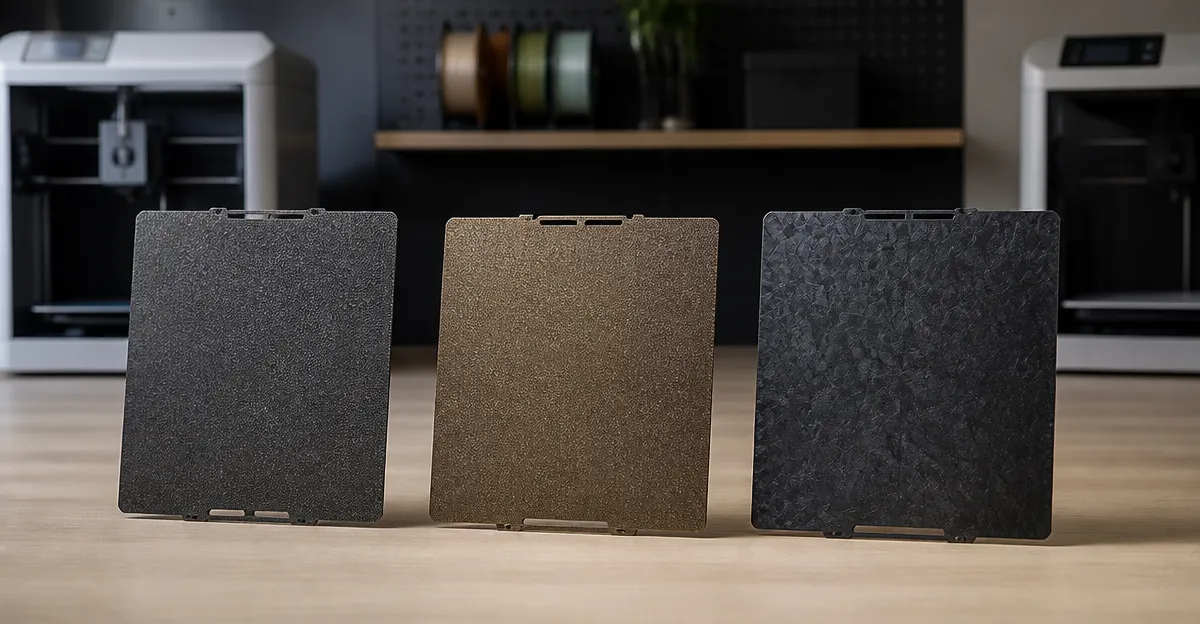
Introduction
Choosing the right build plate is a critical decision for owners of Bambu‑Lab 3D printers. The build plate influences first‑layer adhesion, print warping, power consumption, and overall workflow efficiency. This article compares five Amazon‑available plates that claim to improve adhesion while reducing heat requirements. By analysing price, specifications, customer feedback, and real‑world performance, readers can determine which plate aligns with their printing goals.
Individual Product Overviews
BIQU CryoGrip Pro Frostbite (BIQU Store)
- Price: $24.40
- Rating: 4.4/5 from 530 reviews
- Key strengths: room‑temperature printing for PLA (30‑50 °C) and PETG (50‑70 °C), seven‑layer cobalt‑oxide coating, magnetic attachment, and easy tool‑free removal.
- Customer quote: “The same part printed perfectly on the first attempt… adhesion has been excellent once configured properly.”
BIQU CryoGrip Pro Frostbite (BIGTREETECH Store)
- Price: $24.40
- Rating: 4.5/5 from 451 reviews
- Key strengths: identical seven‑layer design, zero‑heat adhesion for PLA and PETG, energy savings of 50 W/h, and an AR code for X1C recognition.
- Customer quote: “Everything sticks like glue, I never have to glue or change temperatures for any filament.”
SAHVAIM Textured PEI Plate
- Price: $16.59
- Rating: 4.6/5 from 211 reviews
- Key strengths: 0.77 mm thick flexible spring steel, dual‑sided textured PEI surface, high‑temperature resistance up to 300 °C, and magnetic attachment.
- Customer quote: “Works perfectly on my Bambu P2S and P1S printers. No problems being recognized by the printer.”
BIQU CryoGrip Pro Glacier Plate
- Price: $25.99
- Rating: 4.5/5 from 864 reviews
- Key strengths: low‑temperature adhesion (45‑55 °C for PLA), honeycomb heat‑insulating handle, customizable AR‑code stickers, and dual‑sided texture.
- Customer quote: “The proprietary chemical formulation is incredibly tacky… first‑layer corner lifting completely impossible.”
YOOPAI Double‑Sided Resin Build Plate
- Price: $9.89
- Rating: 4.5/5 from 213 reviews
- Key strengths: epoxy resin surface, double‑sided PEI, compatible with a wide filament range, and the lowest price among the tested plates.
- Customer quote: “Very durable, excellent adhesion, and the bottom of the prints have a nice matte finish.”
Head‑to‑Head Comparison
Price and Value
The YOOPAI plate offers the most economical entry point at $9.89, delivering acceptable adhesion for a broad filament set. The two BIQU Frostbite versions share the same price of $24.40, providing advanced cold‑print technology and magnetic convenience. The SAHVAIM PEI plate costs $16.59, positioning it between the low‑cost resin plate and the premium BIQU offerings. The BIQU Glacier plate is the most expensive at $25.99, but it includes a heat‑insulating handle and a customizable AR‑code, which may justify the modest premium for users seeking rapid, low‑temperature workflows.
Features and Specifications
| Feature | BIQU CryoGrip Frostbite (BIQU Store) | BIQU CryoGrip Frostbite (BIGTREETECH) | SAHVAIM Textured PEI | BIQU CryoGrip Glacier | YOOPAI Resin Plate |
|---|---|---|---|---|---|
| Build Size | 257 × 257 mm | ||||
| Material Layers | 7‑layer cobalt‑oxide | 7‑layer polymer | PEI on spring steel | 7‑layer polymer + honeycomb handle | Epoxy resin + PEI |
| Recommended PLA Temp | 30‑50 °C | 30‑50 °C | Typically 60‑70 °C (heated bed) | 45‑55 °C | Standard 60 °C (heated bed) |
| Energy Savings | ~50 W/h | ~50 W/h | None reported | ~50 W/h | None reported |
| Magnetic Attachment | Yes | Yes | Yes | Yes | Yes |
| AR‑Code Compatibility | Included for X1C | Included for X1C | None | Customizable stickers | None |
| Cleaning Method | Water & soap | Water & soap (no alcohol) | Detergent & water (no acetone) | Water, soap, or alcohol | Water & soap |
Customer Ratings and Feedback
All five plates maintain high ratings above 4.4 stars. The SAHVAIM PEI plate achieves the highest average at 4.6, reflecting satisfaction with its durability and dual‑sided design. The BIQU Glacier plate, despite a higher price, holds a solid 4.5 rating supported by comments on its “tacky” surface and heat‑insulating handle. Both Frostbite versions receive praise for eliminating the need for glue and for significant power savings. The YOOPAI plate, while the cheapest, also secures a 4.5 rating, with users highlighting its matte finish and resilience over months of daily use.
Performance and Reliability
Cold‑print technology distinguishes the Frostbite and Glacier plates. Users report successful prints of large overhangs and tall models without warping when printing PLA at 40 °C. The Glacier plate extends this capability to temperatures as low as 25 °C, enabling near‑instant start‑up. The SAHVAIM PEI plate relies on traditional heated‑bed temperatures but offers high‑temperature resistance up to 300 °C, making it suitable for engineering filaments such as ABS and Nylon. The YOOPAI resin plate provides reliable adhesion for PLA, PETG, TPU, and even carbon‑filled PET, yet it does not claim cold‑print benefits.
Best Use Cases
- BIQU CryoGrip Frostbite (both stores): Ideal for users who prioritize energy efficiency, rapid start‑up, and consistent adhesion for PLA and PETG without glue.
- BIQU CryoGrip Glacier: Suited for high‑volume prototyping where minimal bed heating and a heat‑insulating handle reduce cycle time.
- SAHVAIM Textured PEI: Best for printers that frequently switch between high‑temperature filaments such as ABS, Nylon, or PC.
- YOOPAI Double‑Sided Resin: Perfect for budget‑conscious hobbyists needing a durable, dual‑sided surface for a wide filament range.
Pros & Cons
BIQU CryoGrip Frostbite (BIQU Store)
- Pros: Low‑temperature adhesion, 50 % power reduction, magnetic attachment, easy tool‑free removal.
- Cons: Requires cooling before part removal, learning curve for optimal settings.
BIQU CryoGrip Frostbite (BIGTREETECH)
- Pros: Same cold‑print benefits, AR‑code for X1C, no alcohol cleaning.
- Cons: Some users report barcode not recognized on certain models.
SAHVAIM Textured PEI
- Pros: High temperature resistance, dual‑sided texture, flexible spring steel prevents warping.
- Cons: Requires heated bed, may need glue for very aggressive filaments.
BIQU CryoGrip Glacier
- Pros: Ultra‑low temperature adhesion, heat‑insulating handle, customizable AR‑code, dual texture.
- Cons: Slightly higher price, occasional need for metal scraper on extremely tacky prints.
YOOPAI Double‑Sided Resin Plate
- Pros: Lowest cost, durable epoxy resin surface, works well with TPU and PET‑CF, easy flex removal.
- Cons: Does not enable room‑temperature printing, texture may be less pronounced than Frostbite plates.
Recommendations
For users who print primarily PLA and PETG and wish to reduce energy consumption, the BIQU CryoGrip Frostbite (BIQU Store) or its BIGTREETECH counterpart provide the best balance of price and performance. Professionals needing high‑temperature capability for ABS, Nylon, or PC should consider the SAHVAIM Textured PEI Plate. Small workshops focused on rapid prototyping and low‑temperature workflows will benefit most from the BIQU CryoGrip Glacier Plate. Finally, hobbyists on a tight budget who still require reliable adhesion across many filament types should select the YOOPAI Double‑Sided Resin Build Plate.
FAQ
- Do the Frostbite plates work with all Bambu‑Lab models?
- Yes, they are compatible with P1S, P1P, P2S, X1C, X1E, X2D, and A1. Users must disable the build‑plate detection feature on X2D and P2S.
- Can I use alcohol to clean the Frostbite plates?
- The BIGTREETECH Frostbite version advises against alcohol; water and mild soap are recommended. The Glacier plate permits alcohol, but the BIQU Store Frostbite version prefers soap only.
- Is a heated bed required for the SAHVAIM PEI plate?
- Yes, the PEI surface relies on conventional heated‑bed temperatures (typically 60‑70 °C for PLA) to achieve optimal adhesion.
- Will the YOOPAI resin plate work with carbon‑filled filaments?
- Customers report successful prints with PET‑CF, noting that the plate releases without glue and leaves a smooth matte finish.
- How long does the magnetic attachment last?
- All plates use a magnetic steel core. User feedback indicates the magnets retain strength after months of regular flexing and cleaning.
Conclusion
All five build plates deliver high ratings and solid performance for Bambu‑Lab printers. The decision hinges on temperature preferences, filament variety, and budget. Cold‑print technology in the Frostbite and Glacier plates offers the greatest energy savings and rapid start‑up, while the SAHVAIM PEI plate excels for high‑temperature engineering materials. The YOOPAI resin plate provides an affordable, versatile solution for hobbyists. Based on the data, the BIQU CryoGrip Pro Frostbite (BIQU Store) emerges as the overall best value for most users, delivering low‑temperature adhesion, magnetic convenience, and consistent positive feedback.
Products Mentioned in This Review
Frequently Asked Questions
What is the main advantage of the BIQU CryoGrip Pro Frostbite build plate for Bambu Lab printers?
It enables room‑temperature printing for PLA and PETG with strong adhesion thanks to its seven‑layer cobalt‑oxide coating.
How does magnetic attachment improve the workflow when swapping build plates?
It allows tool‑free removal and quick replacement, reducing downtime between prints.
Can the CryoGrip Pro plates reduce the printer’s heat requirements?
Yes, their high‑adhesion surface lets users print at lower bed temperatures, saving energy and minimizing warping.
Are the Amazon‑listed build plates compatible with all Bambu Lab models?
They are designed for the standard Bambu Lab build size and work with most models, but users should verify dimensions for specific printers.
What should users consider when choosing between BIQU, SAHVAIM, and YOOPAI plates?
Compare price, coating material, temperature range, and user reviews to match the plate’s strengths with the filament types they print most often.