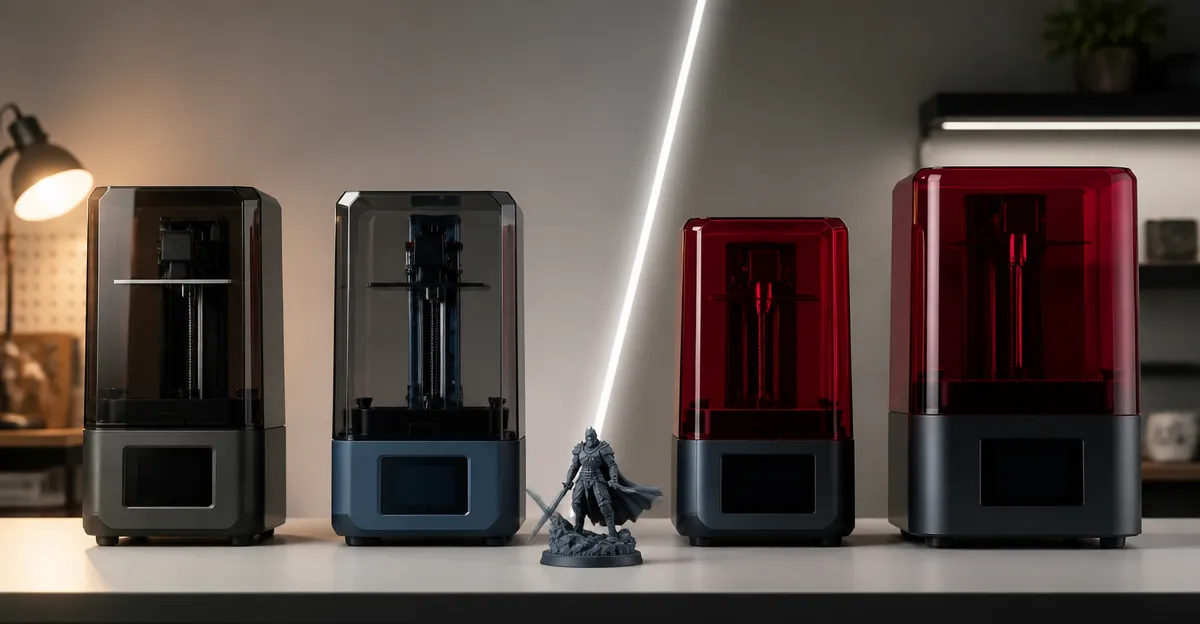
Introduction
Resin 3D printing has become a cornerstone for creators who require high detail, smooth surfaces and rapid prototyping. This article compares four popular Amazon‑available resin printers: Anycubic Photon Mono 4, Elegoo Mars 5, Elegoo Mars 5 Ultra and Elegoo Saturn 4. Understanding how they differ in price, specifications, user feedback and reliability helps buyers select the machine that aligns with their workflow and budget.
Individual Product Overviews
Anycubic Photon Mono 4
The Photon Mono 4 features a 7‑inch 10K monochrome LCD with a resolution of 9024 × 5120 pixels, delivering a pixel size of 17 µm. Its LighTurbo matrix light source provides uniform illumination that reduces raster lines. The printer offers a build volume of 153.4 mm × 87 mm × 165 mm and a 4‑point manual leveling system that requires adjustment only once. At a price of $199.99 it holds a 4.4‑star rating from 518 reviews.
Elegoo Mars 5
The Mars 5 employs a 4K monochrome LCD with a build area of 5.65 × 3.53 × 5.91 inches (143.5 mm × 89.7 mm × 150 mm). It includes automatic leveling, a textured build plate for adhesion and a flip‑lock plate design that simplifies removal. Priced at $199.99 it carries a 4.1‑star rating from 157 reviews. Users praise its ease of use but note occasional FEP film installation challenges.
Elegoo Mars 5 Ultra
The Mars 5 Ultra upgrades to a 7‑inch 9K LCD (resolution 11520 × 6480) and introduces a tilting vat, self‑zeroing build plate and built‑in Wi‑Fi camera. Its build volume matches the Photon Mono 4 at 153.4 mm × 77.6 mm × 165 mm. The printer ships with a three‑month Chitubox Pro subscription and costs $299.99, earning a 4.2‑star rating from 361 reviews. Reviewers highlight fast prints and remote monitoring, while some criticize the lid design and resin spout.
Elegoo Saturn 4
The Saturn 4 targets large‑format users with a 10‑inch 12K LCD (11520 × 5120 pixels) and a build volume of 219 mm × 123 mm × 220 mm. It combines a COB light source with a Fresnel collimating lens for high uniformity and low astigmatism. Priced at $359.99 it holds a 4.1‑star rating from 96 reviews. Customers appreciate the large build area and fast printing, yet a minority report firmware and leveling support issues.
Head‑to‑Head Comparison
Price and Value
- Photon Mono 4 and Mars 5 are priced equally at $199.99, offering entry‑level cost with respectable feature sets.
- Mars 5 Ultra adds Wi‑Fi, tilting vat and higher resolution for $100 more, representing a mid‑range value proposition.
- Saturn 4 commands $359.99, justified by its large 12K screen and professional‑grade optics.
Features and Specifications
| Feature | Photon Mono 4 | Mars 5 | Mars 5 Ultra | Saturn 4 |
|---|---|---|---|---|
| LCD Size | 7" 10K | 5.5" 4K | 7" 9K | 10" 12K |
| Resolution (XY) | 17 µm | ~35 µm | ~22 µm | 19 × 24 µm |
| Build Volume (mm) | 153 × 87 × 165 | 143 × 90 × 150 | 153 × 78 × 165 | 219 × 123 × 220 |
| Light Source | LighTurbo matrix | Standard LCD backlight | LighTurbo + Wi‑Fi | COB + Fresnel lens |
| Leveling | 4‑point manual | Automatic (not always perfect) | Smart automatic (self‑zeroing) | Auto‑level with self‑check |
| Special Features | Laser‑engraved platform 2.0 | Flip‑lock plate | Tilting vat, camera, Wi‑Fi | AI monitoring, dual‑inlet tank |
| Price (USD) | 199.99 | 199.99 | 299.99 | 359.99 |
| Rating | 4.4/5 (518) | 4.1/5 (157) | 4.2/5 (361) | 4.1/5 (96) |
Customer Ratings and Feedback
The Photon Mono 4 enjoys the highest average rating (4.4) with reviewers highlighting "fantastic print quality" and "quick setup". One user noted, "Great printing 90% of the time," while another praised the printer’s ability to resume after power loss. The Mars 5 receives a 4.1 rating; positive comments focus on the flip‑lock plate and ease of use, but several users complain about FEP film installation difficulty. The Mars 5 Ultra’s 4.2 rating reflects enthusiasm for speed and remote monitoring, yet a few negative reviewers report adhesion failures and a cumbersome lid. Saturn 4’s 4.1 rating is supported by praise for large volume and detail, but some users experience firmware‑related support delays.
Performance and Reliability
All four machines employ monochrome LCDs that extend screen life and increase curing speed. The Photon Mono 4’s LighTurbo matrix delivers uniform exposure, reducing layer lines. Users report occasional warping on larger prints, yet the printer’s resume‑after‑power‑loss feature mitigates material loss. The Mars 5’s automatic leveling can be inconsistent, especially when resin particles interfere with sensors, leading to occasional failed prints. The Ultra’s tilting vat reduces peel forces, resulting in faster prints and less wear on the FEP film, though the lid’s lack of hinges may inconvenience frequent access. Saturn 4’s COB light and Fresnel lens provide superior uniformity, supporting high‑resolution 12K output, but the larger size demands more workspace and careful handling.
Best Use Cases
- Photon Mono 4: Hobbyists and small‑business owners who need high detail (10K) at a modest budget.
- Mars 5: Beginners seeking a straightforward, plug‑and‑play experience with automatic leveling.
- Mars 5 Ultra: Users who value speed, remote monitoring, and Wi‑Fi connectivity for iterative design cycles.
- Saturn 4: Professionals requiring large build volume and ultra‑high detail for architectural models or large figurines.
Pros & Cons
Anycubic Photon Mono 4
- Pros: 10K resolution, stable LighTurbo light source, affordable price, laser‑engraved build plate, power‑loss recovery.
- Cons: Manual 4‑point leveling may be intimidating for absolute beginners, occasional warping on large prints, resin vat can be fragile.
Elegoo Mars 5
- Pros: Automatic leveling, flip‑lock build plate, user‑friendly interface, low price point.
- Cons: FEP film replacement is time‑consuming, leveling not always perfect, occasional UI glitches reported.
Elegoo Mars 5 Ultra
- Pros: Tilting vat speeds up printing, built‑in Wi‑Fi camera, self‑zeroing plate, 9K resolution, Chitubox Pro subscription.
- Cons: Lid lacks hinges, resin spout design can cause spills, higher price.
Elegoo Saturn 4
- Pros: Largest build volume, 12K resolution, COB + Fresnel lighting for uniform exposure, AI monitoring, dual‑inlet tank.
- Cons: Premium price, larger footprint, some users experience firmware or leveling support delays.
Recommendations
For creators who prioritize resolution without exceeding $200, the Anycubic Photon Mono 4 offers the best balance of detail and price. Beginners who desire a hassle‑free setup should consider the Elegoo Mars 5, as its automatic leveling reduces the learning curve. Professionals needing faster turnaround and remote oversight will benefit from the Elegoo Mars 5 Ultra, especially when printing medium‑size parts. Finally, large‑scale projects such as architectural prototypes or multi‑part figurines are best served by the Elegoo Saturn 4, which justifies its higher cost with a 12K screen and expansive build envelope.
FAQ
- Which printer has the highest resolution?
- The Photon Mono 4 provides a 10K resolution (17 µm pixel size), while the Saturn 4 offers 12K (19 × 24 µm) and the Mars 5 Ultra delivers 9K. In pure pixel density, the Photon Mono 4 is the most detailed among the sub‑$300 models.
- Do any of these printers support Wi‑Fi?
- Only the Mars 5 Ultra includes built‑in Wi‑Fi for wireless file transfer and remote camera monitoring.
- Can I resume a print after a power outage?
- Both the Photon Mono 4 and Saturn 4 have automatic resume capabilities. The Mars 5 Ultra also resumes, while the basic Mars 5 may require manual restart.
- How difficult is the FEP film replacement?
- Users report that the Mars 5’s FEP film is harder to replace because it must be loosely positioned before tightening. The Photon Mono 4 and Saturn 4 use more straightforward lock‑in designs. The Ultra’s tilting vat reduces wear on the FEP film.
- Which printer offers the largest build volume?
- The Saturn 4 provides the largest volume at 219 × 123 × 220 mm, followed by the Photon Mono 4 and Mars 5 Ultra at approximately 153 × 87 × 165 mm.
- Is there a warranty or support concern?
- All four manufacturers provide standard Amazon warranties. However, some reviewers note slower response from Elegoo support for Saturn 4 firmware issues, whereas Anycubic users frequently mention quick replacement of LCD screens.
- Do I need additional software?
- Any printer can use free slicers such as ChiTuBox. The Mars 5 Ultra includes a three‑month ChiTuBox Pro subscription, which adds advanced support generation features.
Conclusion
Each resin printer examined delivers a distinct blend of resolution, build size, convenience and price. The Anycubic Photon Mono 4 stands out for its 10K detail and low cost, making it ideal for detail‑oriented hobbyists. The Elegoo Mars 5 excels in beginner friendliness with automatic leveling. The Elegoo Mars 5 Ultra offers the most advanced workflow features, justifying its higher price for users who need speed and remote monitoring. Finally, the Elegoo Saturn 4 provides professional‑grade volume and 12K precision for large‑scale projects. Prospective buyers should match their specific use case to the strengths outlined above to make an informed purchase.
Products Mentioned in This Review
Frequently Asked Questions
Do I need an enclosure when using the Anycubic Photon Mono 4 or Elegoo Mars 5 resin printers?
An enclosure is recommended to contain fumes and maintain temperature stability, but it’s not strictly required for short prints in a well‑ventilated area.
How does the 10K LCD resolution of the Photon Mono 4 compare to the Mars 5 series?
The Photon Mono 4’s 9024×5120 pixel LCD (17 µm pixel size) offers finer detail than the Mars 5’s 8K screen, resulting in sharper prints at similar layer heights.
Which printer provides the best value for high‑detail resin printing on a budget?
The Anycubic Photon Mono 4 typically offers the lowest price per micron of detail, making it a strong budget choice for fine‑resolution prints.
Are there notable reliability differences between the Mars 5 Ultra and Saturn 4?
Both are reliable, but the Saturn 4’s larger build volume and upgraded light source can handle longer runs with fewer interruptions compared to the Mars 5 Ultra.
What are the key factors to consider when choosing between these four resin printers?
Consider build volume, LCD resolution, price, light source type, and community support to match the printer to your project size and quality requirements.